DFG fördert UMM-Forschung zum Herzschutz nach Myokardinfarkt
Die UMM erhält rund 500.000 Euro für ein Forschungsprojekt zum Schutz des Herzmuskels nach einem Infarkt. Das Ziel: Ein neuer Therapieansatz für das gesamte Organ.
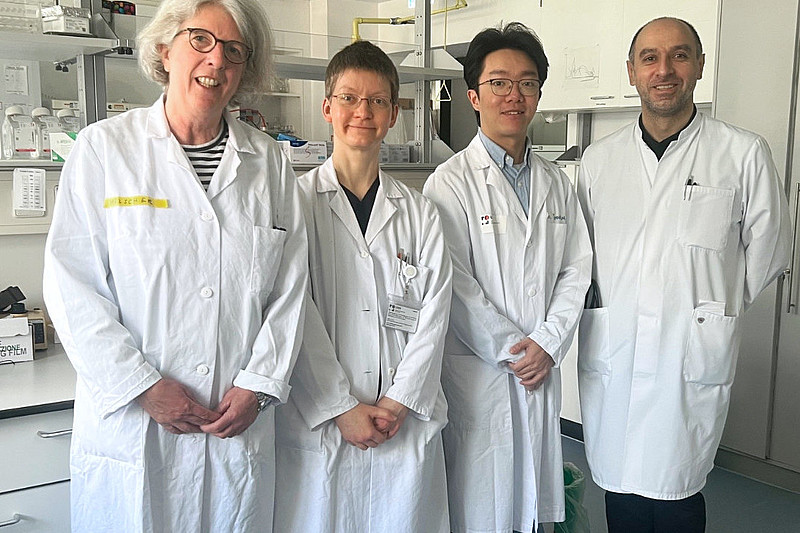
v.l.n.r.: Dr. Christina Hölscher, Dr. Katherine Sattler, Yuanhan Ao, Prof. Dr. Ibrahim Akin
Die Arbeitsgruppe “Cardiomyocytes as basic units of cardiovascular diseases” (Leitung: Dr. med. Katherine Sattler, Prof. Dr. med. Ibrahim Akin erhält für ein Projekt der Sektion Invasive Kardiologie und Elektrophysiologie (IKED) der I. Medizinischen Klinik eine Förderung der Deutschen Forschungsgesellschaft (DFG).
Das Projekt „Schutz des Remote Myokards nach Herzinfarkt durch mitochondriale Komplex-I-Hemmung“ befasst sich mit dem sogenannten Remote Myokard.
Dabei handelt es sich um den Anteil des Herzmuskels, der während eines Herzinfarkts nicht von der Durchblutungsstörung betroffen ist, im späteren Verlauf jedoch entscheidend zur Ausbildung von Herzschwäche und Herzrhythmusstörungen beiträgt.
Das Ziel dieses Projekts der Grundlagenforschung ist es, die Signalwege und Gen-Expressionen im entfernten Myokard im Tiermodell und in der Zellkultur zu entschlüsseln und diesen Herzmuskelanteil mit einem neuartigen pharmakologischen Ansatz vor den Folgen eines Herzinfarkts zu schützen.
Das langfristige Ziel ist die Entwicklung einer neuen Therapie bei Herzinfarkt, die nicht nur das Infarktgebiet mittels Wiedereröffnung der Herzkranzarterie (Herzkatheteruntersuchung/Stentimplantation) behandelt, sondern das gesamte Organ.
English Version:
The German Research Foundation (DFG) has approved funding of a research project of the group “Cardiomyocytes as basic units of cardiovascular diseases” (Dr. med. Katherine Sattler, Prof. Dr. med. Ibrahim Akin), division of Invasive Cardiology and Electrophysiology (IKED) of the I. Medical Clinic, with a volume of ca. 500.000 Euro.
The project “Protection of the remote myocardium after myocardial infarction by mitochondrial complex I inhibition” targets the so-called remote myocardium, the part of the heart muscle which is not affected by perfusion deficit during myocardial infarction, but nevertheless plays an eminent role for occurrence of heart failure and arrhythmias during the post-infarction phase.
Aim of this basic research project is the discovery of participating signaling pathways and of gene expression changes in the remote myocardium, and subsequent protection of the myocardium by a novel pharmacologic approach. On the long run, this aims at developing a new method of treatment during myocardial infarction which does not only target the diseased vessel by catheterization or stent implantation, but the whole organ.